Product Descriptions
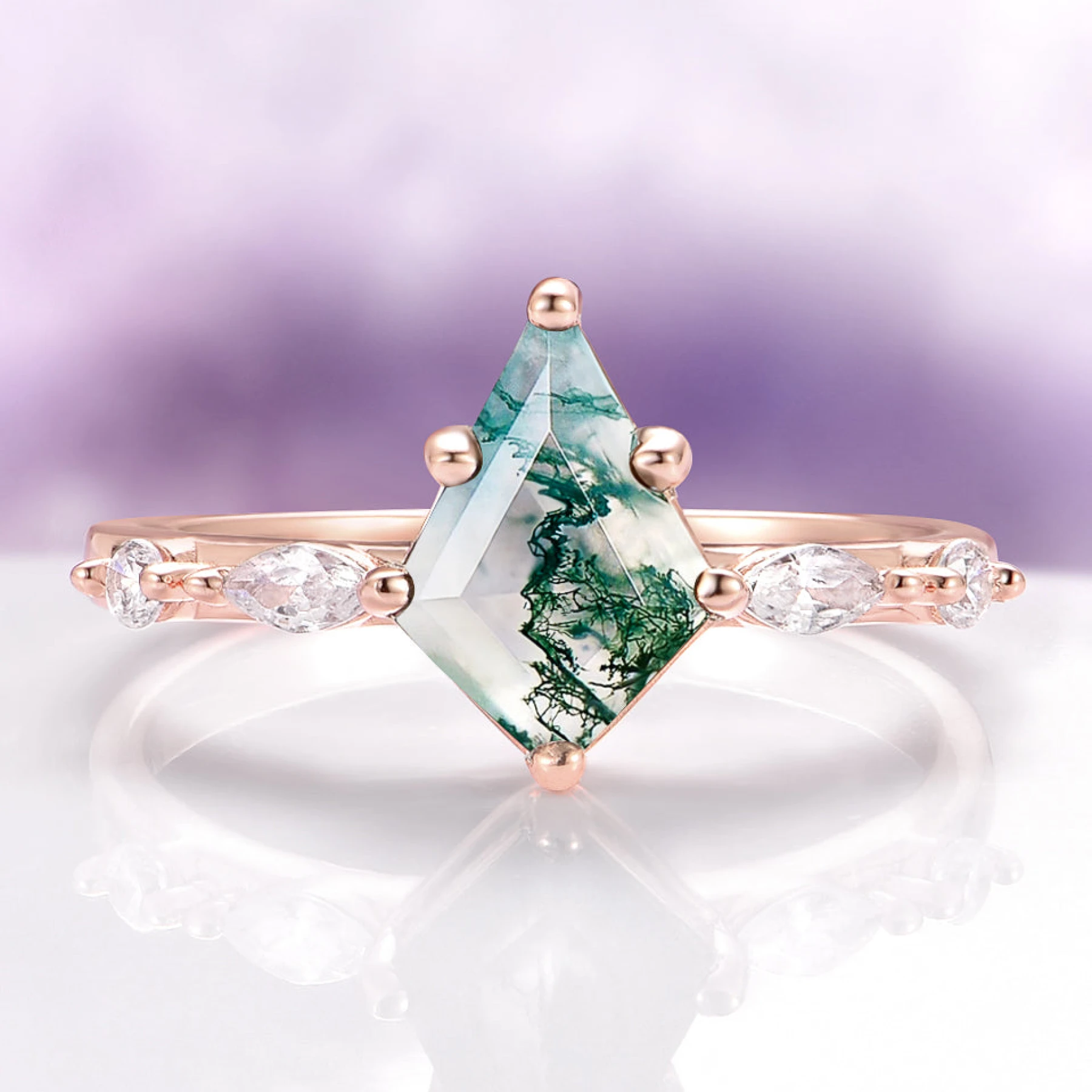
A kite cut moss agate ring in solid rose gold. The center stone is a natural green moss agate cut to an elongated 7.0 x 10.0 mm kite — roughly 1.4 carats — with the dendritic green inclusions that give the stone its name suspended inside translucent chalcedony. Because the inclusions form naturally, no two of these rings are the same.
Why the kite cut suits moss agate
A kite is an elongated hexagon with a point at each end and angled shoulders — the same geometry sometimes sold as a coffin cut. On a brilliant stone that shape is chosen for how it throws light. On moss agate it does something more useful: the long flat table acts like a window. Moss agate is translucent rather than transparent, and its appeal lies in the pattern held inside it, so a broad open facet shows more of that pattern than a domed or heavily faceted cut would.
The elongation also works in the ring’s favor on the hand, drawing a line along the finger rather than sitting as a round dot. If you want to compare it against the oval, hexagon and emerald options, our guide to the best cuts for moss agate rings lays them out side by side, and you can browse the shape across other stones in our kite cut engagement rings.
Rose gold against green
Rose gold is the warmest of the three gold colors, and warm metal against cool green is the oldest trick in gemstone setting — the two sit opposite enough on the color wheel that each makes the other look more saturated. Against white gold moss agate reads cooler and more mineral; against rose it reads warmer and more botanical.
The band is a slim 1.7 mm, which keeps the focus on the stone and makes the ring easy to stack later. Our comparison of moss agate in gold versus silver covers how each metal changes the stone’s appearance, and the 10K vs 14K vs 18K guide explains what the karat choice actually changes.
Every stone is different
This matters more with moss agate than with almost any other gem. The green is not a color the whole stone shares — it is mineral inclusions, usually chlorite or hornblende, that grew inside the chalcedony as it formed. Density, branching and distribution vary from stone to stone. Yours will share the same green character as the moss agate in our photographs, with its own individual pattern.
That is the point of the stone rather than a caveat on it. More on where the material comes from and what it has meant historically in moss agate meaning, and for the full buying picture, our moss agate engagement ring guide.
Specifications
- Center stone Natural moss agate
- Stone shape Kite
- Stone size 7.0 x 10.0 mm
- Carat weight 1.4 ct (approximate)
- Stone hardness 6.5–7 on the Mohs scale
- Metal Solid rose gold — 10K, 14K or 18K
- Accent stones Moissanite (lab-grown)
- Band width 1.7 mm approximate
- Fit Comfort fit
- Engraving Complimentary, up to 16 characters
- Sourcing Conflict-free and ethically sourced
- Production Made to order, 3–5 weeks
- Included Free luxury ring box, free USA shipping
Care
Moss agate sits at 6.5–7 on the Mohs scale — durable enough for an engagement ring worn daily, but below sapphire or diamond, so it will scratch if you let it meet something harder. Take it off for gardening, gym work and anything abrasive.
Clean with warm water, a drop of mild soap and a soft brush. Skip ultrasonic and steam cleaners: agate is porous enough that heat and vibration are a genuine risk. Our notes on cleaning a moss agate ring safely and whether moss agate is durable enough for daily wear go into more detail. Solid gold holds its color permanently — there is no plating here to wear through.
More in the same register across our moss agate engagement rings and the wider range of solid gold engagement rings.
Frequently asked questions
Is the moss agate natural?
Yes. The center stone is natural moss agate, mined and cut rather than lab-created or simulated. Its green inclusions formed inside the stone as it grew.
Is a kite cut the same as a coffin cut?
Yes — they describe the same geometric shape, an elongated hexagon with pointed ends and angled sides. Kite tends to be used in geometric and architectural contexts, coffin in gothic ones.
Will my stone look exactly like the photos?
It will share the same green character and translucency, but the inclusion pattern will be its own. Moss agate is never identical stone to stone.
Is this solid gold or plated?
Solid gold throughout, in whichever karat you select. There is no plating and no base metal core, so the color is permanent.
Which karat should I choose?
10K is the hardest and most affordable. 14K is the most popular balance of durability and gold content. 18K has the highest gold content and the richest, warmest rose tone.
What are the accent stones?
Moissanite — a lab-grown gemstone, not a simulant. It is exceptionally brilliant and hard enough for daily wear.
Is moss agate durable enough for an engagement ring?
Yes, with sensible care. At 6.5–7 on the Mohs scale it handles daily wear, but it is softer than diamond or sapphire and should be protected from knocks and abrasive work.
How wide is the band?
Approximately 1.7 mm — a deliberately slim profile that keeps attention on the center stone and stacks easily with a wedding band.
Can I have this in yellow or white gold?
Yes, on request. Rose gold is the default for this design, but 14K yellow and white gold are both available — contact us for a quote.
How long does it take to make?
This ring is made to order. Please allow 3–5 weeks for production. Requested modifications may extend that timeline.
Is engraving included?
Yes, complimentary, up to 16 characters.
Can I clean it in an ultrasonic cleaner?
No. Agate is porous and sensitive to heat and vibration. Use warm water, mild soap and a soft brush instead.

There are no reviews yet.
No loaded reviews match this filter. Load more reviews or choose another rating.